On-Device Verification, Explained (Nothing Leaves Your iPhone)
Why Verifyco runs entirely on your iPhone: how on-device forensic analysis works, what the Neural Engine does, cloud vs on-device trade-offs, and why nothing is ever uploaded.
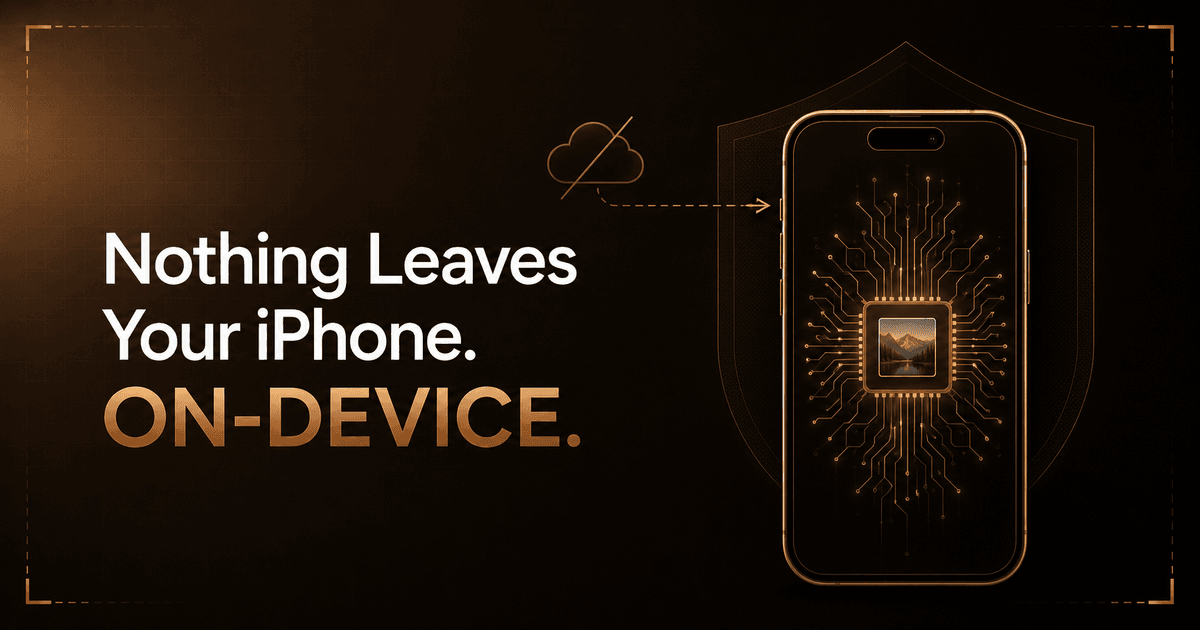
Most media-checking tools work the same way: you upload your file to a server, their models analyse it in the cloud, and you get a result back. Verifyco doesn’t. Every signal runs locally on your iPhone, and your photos and videos never leave the device. Here’s what that means, how it’s possible, and why it matters — especially for the sensitive material people most often need to check.
Why on-device matters
- Privacy. The media you most want to verify is often the most sensitive — a private photo, a leaked clip, an intimate image someone sent you. On-device analysis means it never touches someone else’s server, never sits in a log, and can’t leak from a breach that isn’t yours.
- Speed. No upload, no queue, no round-trip. Analysis starts the instant you pick a file — which matters when you’re checking a 4K video, not a thumbnail.
- Works offline. On a plane, on patchy signal, or in a secure environment with no network — it still works, because there’s no network call to make.
- No account, no trail. Nothing to sign up for, nothing tying a checked file to your identity.
There is no server. There is no upload. There is no account. Your media stays on your phone, full stop.
What “on-device” actually means
Modern iPhones ship with a dedicated Neural Engine — silicon built specifically for running machine-learning models fast and efficiently. Apple’s Core ML and Vision frameworks let an app run neural networks directly on that hardware.
Verifyco uses this to do, locally, what other tools send to a GPU in a data centre: run neural analysis on faces and scenes, compute frequency transforms, parse metadata and hash the file — all in the phone’s own memory, in seconds, without transmitting a single byte of your media.
The five signals, running locally
Verifyco fuses five independent forensic signals into one 0–100 trust score:
- Content credentials — C2PA provenance, the camera’s signed “receipt” of origin.
- Metadata forensics — EXIF, encoding consistency and frame-rate anomalies.
- Neural face analysis — Apple Vision, frame by frame, looking for the artifacts generators leave behind.
- Motion analysis — optical-flow and temporal consistency across frames.
- Frequency analysis — the DCT spectral fingerprint of diffusion and GAN models, invisible to the eye.
No single layer is decisive — that’s the point. Fusing several independent signals is what makes the verdict robust, because fooling one is easy and fooling all of them at once is hard. (For what each layer catches in practice, see how to tell if an image is AI-generated and 5 signs a video has been deepfaked.)
Cloud vs on-device: the trade-off
| Cloud verification | On-device (Verifyco) | |
|---|---|---|
| Your media | Uploaded to a server | Never leaves your phone |
| Speed | Upload + queue + download | Starts instantly |
| Works offline | No | Yes |
| Account required | Usually | No |
| Privacy exposure | Server logs, breaches | None beyond your device |
The one thing clouds can offer is a giant central model. But for forensic verification, the signals that matter — provenance, metadata, frequency patterns, temporal consistency — run perfectly well on-device, and the privacy gain is enormous.
Common questions
Is on-device as accurate as cloud? For these forensic signals, yes — the analysis is the same math; only the location changes. Detection is always a moving target (generators improve), which is why Verifyco fuses several signals and improves with app updates.
Does it drain my battery? A single analysis is a short burst of Neural Engine work — comparable to applying a heavy photo filter, then done.
Which iPhones? Any modern iPhone with a Neural Engine (iOS 17+). Newer chips simply finish faster.
Do you ever see my files? No. There’s no upload path at all — the feature that would send your media to us doesn’t exist.
The bottom line
On-device verification gives you a forensic-grade second opinion that’s private by design and fast enough to actually use — before you trust a piece of media, and before you share it. New to the topic? Start with what is a deepfake.